Why I Write About Afro-Boricua Lives
By Luis M. Madera Suárez
People often ask why I write about Afro-Boricua history.
The simplest answer is that this is where my own search began.
I did not set out to become a historian. I was looking for my family.
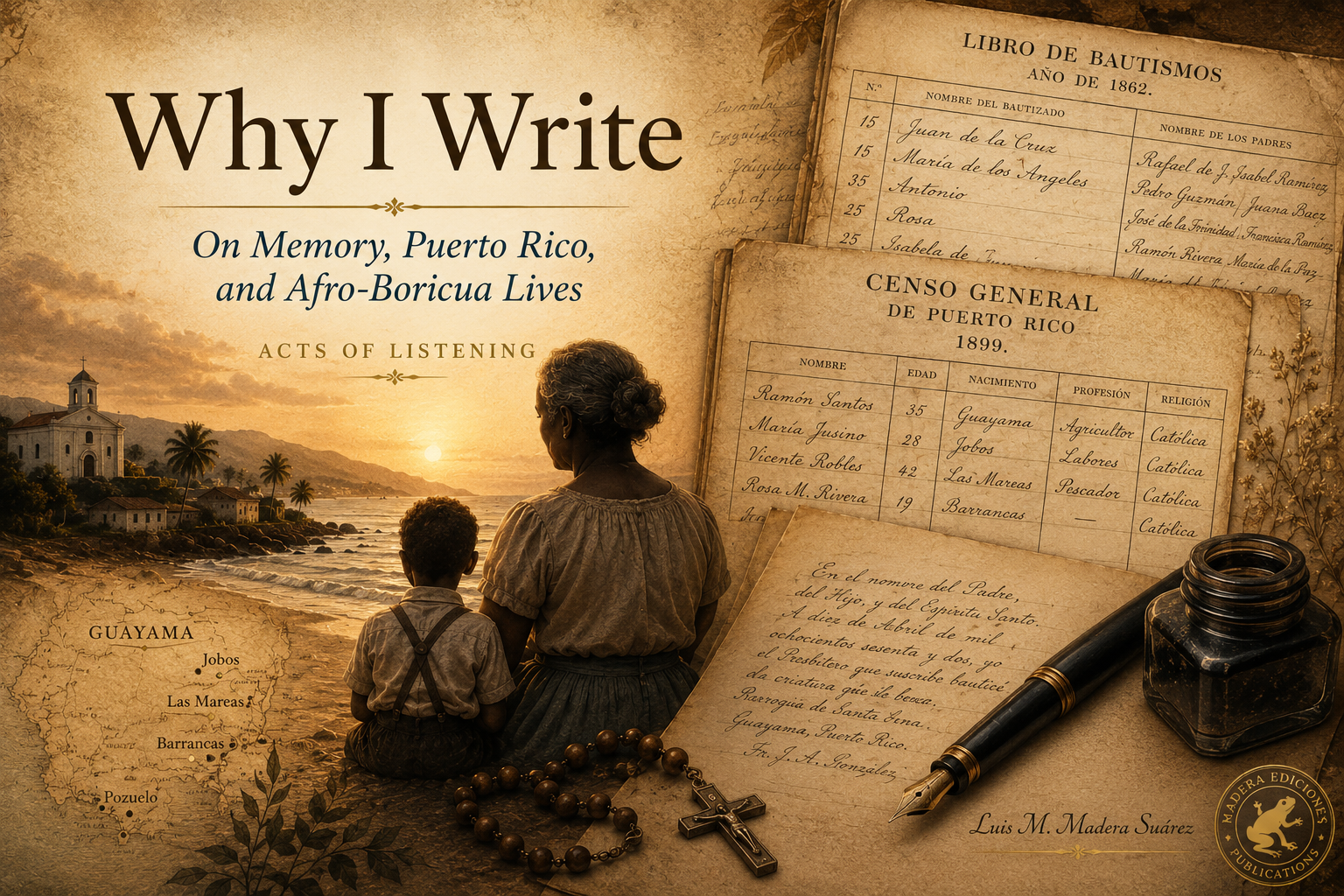
That search led me into parish registers, census pages, wills, forgotten maps, oral histories, and fading memories carried by relatives who understood that every generation loses something if no one asks the questions. Little by little, those fragments revealed lives that rarely appeared in the stories I had learned about Puerto Rico.
Most of them were not famous.
They were mothers who held families together after unimaginable hardship. Fathers who worked land they did not own. Fishermen, laborers, cooks, laundresses, artisans, children, widows, neighbors, and elders whose names survived only because someone wrote them in a church register or because a grandparent refused to let them disappear.
I came to realize that history is not only made by governors, politicians, generals, or celebrated intellectuals. Nations are also built by ordinary people whose daily acts of love, sacrifice, faith, endurance, and work shape generations they will never meet.
Those, too, are the mothers and fathers of a nation.
My writing has focused on Afro-Boricua lives because those were the stories I was able to begin recovering from the records available to me. But I do not see Puerto Rico through a single lens.
Puerto Rico has always been a meeting place of peoples and cultures. African, Indigenous, Spanish, Portuguese, Sephardic, Caribbean, and many others have all contributed to who we are. Some histories have been studied more deeply than others. Some remain difficult to recover. Some I have only begun to understand.
The Indigenous roots of Puerto Rico are among those I still hope to explore more fully. I approach that history not as someone who already has answers, but as someone eager to keep learning.
That is perhaps the most honest thing I can say about my work.
I am not trying to complete Puerto Rico's story.
I am trying to recover the pieces my family helped me find while remaining open to the many pieces I have yet to discover.
If my novels have a purpose, it is not to settle historical debates or to argue for a single interpretation of our past.
It is to listen.
To listen to archives.
To listen to family memory.
To listen to places.
To listen to silence.
And perhaps, through that listening, to remember together what none of us could recover alone.