What the People Carried
By Luis M. Madera Suárez
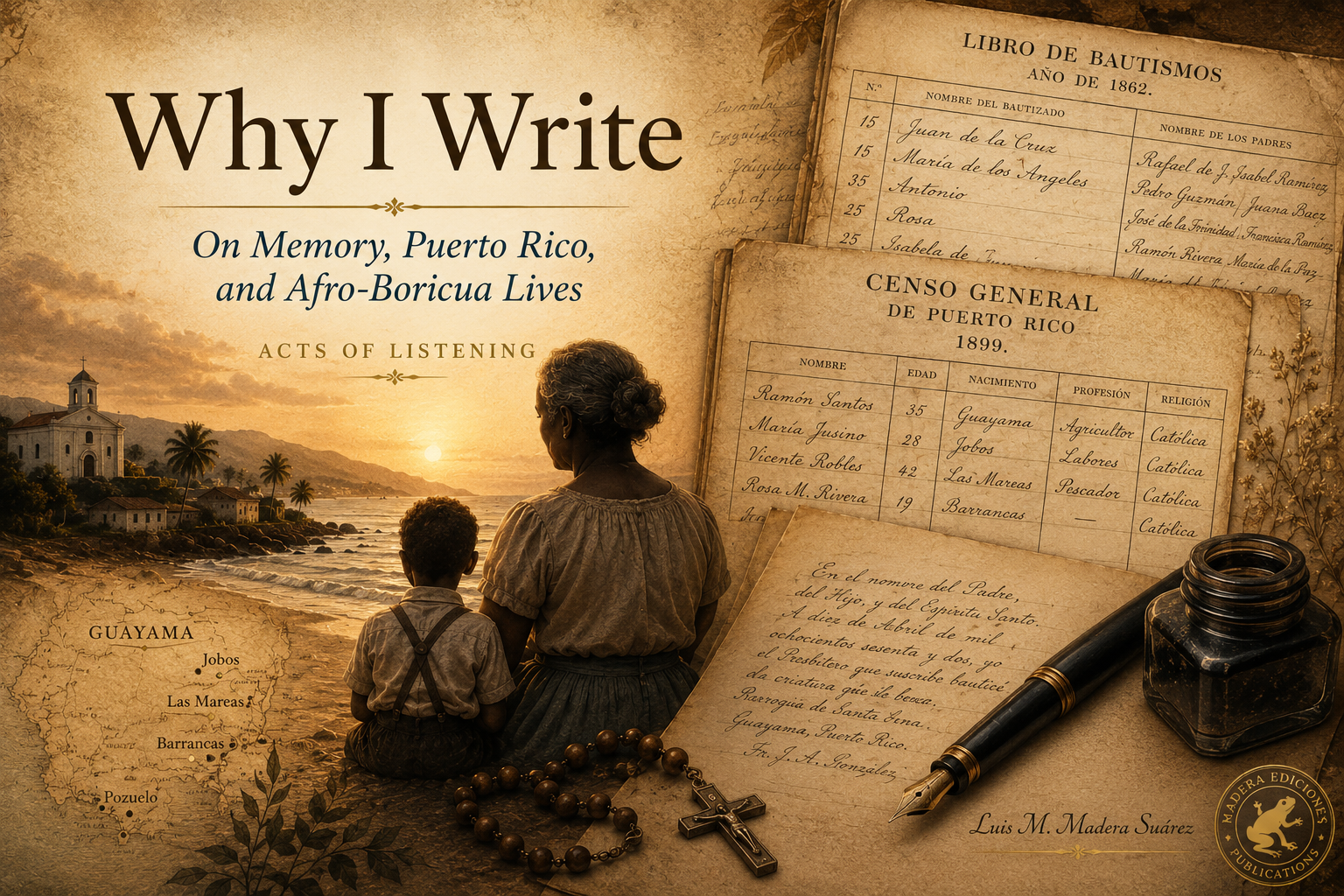
There are places that disappear from maps long before they disappear from the people who once lived there.
Las Mareas is one of those places for me.
I knew it first through fragments. A name spoken by my parents. A road toward the sea. Stories about houses that were no longer there. The remains of an old school. A shoreline that seemed to have swallowed part of what the adults remembered.
As a child, I did not understand that I was walking through the aftermath of a community.
I only knew that people had once lived there.
Years later, I began to understand how much had been lost.
Families left Las Mareas. Houses disappeared. The sea took some things. Development and the transformation of the coast took others. People moved toward Barrancas and neighboring communities, carrying what they could with them.
But they carried more than furniture.
They carried a chapel.
Not the building itself. That was left behind.
They carried what had made the building sacred.
My father remembers the old chapel as a wooden structure with a zinc roof and a concrete floor, large enough for perhaps fifty or sixty people. At the front stood a white altar, marble as he remembers it, built against the wall beneath an arched structure. There were statues that, according to the memory of my family and others from the barrio, had been brought from Spain by Doña Monserrate Bruno—Doña Monse, as everyone called her.
Among them were Santiago and Nuestra Señora de la Monserrate.
Doña Monse is one of those figures who still moves between history and memory in my family. She was a wealthy woman from Guayama, but the stories I inherited about her were stories of generosity. She was my maternal grandmother’s madrina de boda. My grandmother worked for her for a time, ironing clothes. My family remembers that when one of my mother’s brothers was born blind, Doña Monse helped pay for an operation that allowed him to regain partial vision.
My father also remembers that beside the chapel in Las Mareas stood a wooden house belonging to Doña Monse, a weekend house everyone called la Casa Blanca. Closer to the sea there was another house, two stories and built of concrete, where dances were held during the fiestas del Carmen.
The sea eventually took that one.
Memory does not preserve places evenly. A whole building can vanish while one detail remains perfect: the name people gave a house, the color of an altar, the sound of music near the water.
For years, I knew pieces of this story without understanding that I had once participated in it.
After families left Las Mareas, a new chapel began to rise elsewhere. I remember older women from the barrio—including great-aunts from both sides of my family—selling frituras to raise money for its construction.
That memory has become more important to me with age.
There is something almost absurdly small about a fritura beside the cost of constructing a building. Flour, oil, a little filling, a paper napkin, a few coins passing from one hand to another.
Yet communities have always been built from things that appear too small to matter.
Someone mixed the dough.
Someone heated the oil.
Someone stood in the Puerto Rican sun selling food.
Someone bought one more than they needed because they knew what the money was for.
No plaque records those transactions.
No architectural history of the chapel is likely to list the women who stood over hot oil raising a few dollars at a time.
But the chapel rose.
I remember being a child when my father went with my great-aunt and other men to retrieve some of the sacred objects that had been stored after Las Mareas was abandoned. I went with them.
I remember the statues.
I remember the altar.
What I did not understand was what their movement meant.
To me, adults were simply moving old things from one place to another.
The older I become, the less certain I am that objects are ever only objects.
A statue touched by generations of hands carries something that cannot be measured by its material. An altar before which children were baptized, couples prayed, mothers worried, fishermen asked for protection, and families mourned their dead becomes more than stone or wood.
It becomes a witness.
When the people of Las Mareas left, they could not carry the shoreline with them. They could not carry every house. They could not carry the paths they had walked or the places where someone had stood waiting for a husband to return from the sea.
But they could carry Santiago.
They could carry La Monserrate.
They could carry the altar.
And so, in a way I could not have understood as a boy, they carried part of Las Mareas with them.
I spent a great deal of time in church with my great-aunts when I was young. Perhaps that is why I remember things no one thought important enough to record.
I remember Santiago needing repair.
Termites had gotten into the wooden base. Don Santos, a man from the barrio with many stories from his travels and the sort of practical abilities that seemed to come from having learned a little everywhere, took on the work.
I watched him wipe the damaged wood with a rag wet with kerosene.
I asked him why.
He told me it was an old remedy for killing the termite eggs.
Then he cut new pieces of wood for the base, fitted them into place, and painted them gold.
At least everyone called it gold.
To my childhood eyes, it looked more like mustard.
I did not understand then that I was watching another kind of preservation.
The statue had already survived the abandonment of Las Mareas and the journey from one chapel to another. Now its survival depended on a man from the barrio with a rag, some kerosene, pieces of wood, and whatever knowledge his life had taught him.
No conservator stood beside him.
No institution commissioned the work.
Someone simply knew what to do.
I remember another occasion differently.
One of my young catechists was cleaning Nuestra Señora de la Monserrate with a damp cloth.
She moved slowly.
There was reverence in the way she touched the statue, something almost prayerful. I remember watching her and feeling that what I was seeing was beautiful and somehow almost forbidden, as though I had been allowed to witness an intimacy between her and the saint that did not quite belong to me.
No ceremony was taking place.
There was no procession.
No feast day.
No congregation watching.
Someone was simply cleaning a statue.
But perhaps that is how sacred things endure.
One person carries them.
Another repairs them.
Another removes the dust.
Someone sells frituras to give them a new home.
Someone remembers where they once stood.
And one day, a child who understood none of it becomes an adult and realizes what he had been watching.
This is where official history often fails us.
A document may tell us when property changed hands. A church record may identify the date a chapel was blessed. A municipal record may tell us when land was acquired or a structure approved.
Those records matter.
But they cannot tell us who burned the first batch of frituras.
They cannot tell us which woman arrived early.
They cannot tell us why Don Santos reached for kerosene.
They cannot tell us that the gold paint looked mustard-colored to a child.
They cannot tell us how carefully a young catechist moved a damp cloth across the face of La Monserrate.
They cannot tell us what it felt like for people displaced from one community to watch the sacred things of their old chapel enter another.
For those things, we have to listen.
Recently I asked my father about Las Mareas again. He is eighty-one now.
As we spoke, names returned.
Houses returned.
Doña Monse returned.
He remembered the chapel, the white altar, the zinc roof. He remembered the Casa Blanca. He remembered the house closer to the sea where people danced during the fiestas del Carmen. He remembered people for whom my grandmother had worked, places where she had cooked and ironed, relationships that once seemed ordinary enough that no one imagined they would someday need preserving.
Some details arrived confidently.
Others required searching.
One name led to another. One house opened the door to another story. A story about employment became a memory of a chapel. The chapel became a memory of saints. The saints brought me back to my childhood.
That, too, is part of listening.
Memory is not a deposition.
It does not always arrive chronologically. It circles. It interrupts itself. It corrects a name. It places two houses together that later have to be separated. It suddenly remembers an altar more clearly than a date.
Sometimes memory carries uncertainty.
Sometimes it carries mustard-colored gold paint.
And sometimes the child inside the memory knows something the adult narrator has forgotten.
I remember going with my father.
That matters to me now.
I have spent years searching archives for people who died long before I was born. I have studied names on census pages and parish registers, trying to reconstruct entire worlds from ink.
Yet on those days in the chapel, without knowing it, I was standing inside an archive.
The archive was my father.
It was my great-aunts.
It was the women selling frituras.
It was Don Santos cutting wood.
It was a young catechist holding a damp cloth.
It was the men lifting an altar.
It was Santiago surviving termites.
It was La Monserrate being cleaned as though tenderness itself were a form of prayer.
Perhaps this is what displacement cannot completely destroy.
A place may be abandoned.
A house may disappear.
The sea may reclaim the land.
But people carry things.
They carry recipes and prayers. They carry saints and stories. They carry ways of cooking and grieving and welcoming one another. They carry practical remedies and gestures of reverence. They carry the names of people who were generous to them. They carry jokes, arguments, superstitions, songs, and the memory of where a house once stood.
Sometimes they even carry an altar.
I once thought history was what remained behind.
Now I wonder whether history is also what people manage to take with them.
Las Mareas did not survive as it had been.
But neither did it disappear completely.
I know because I once watched its sacred things being cared for by people who never called themselves historians.
And because, all these years later, my father can still tell me where they came from.