Why Those Names,
Why Those People
By Luis M. Madera Suárez
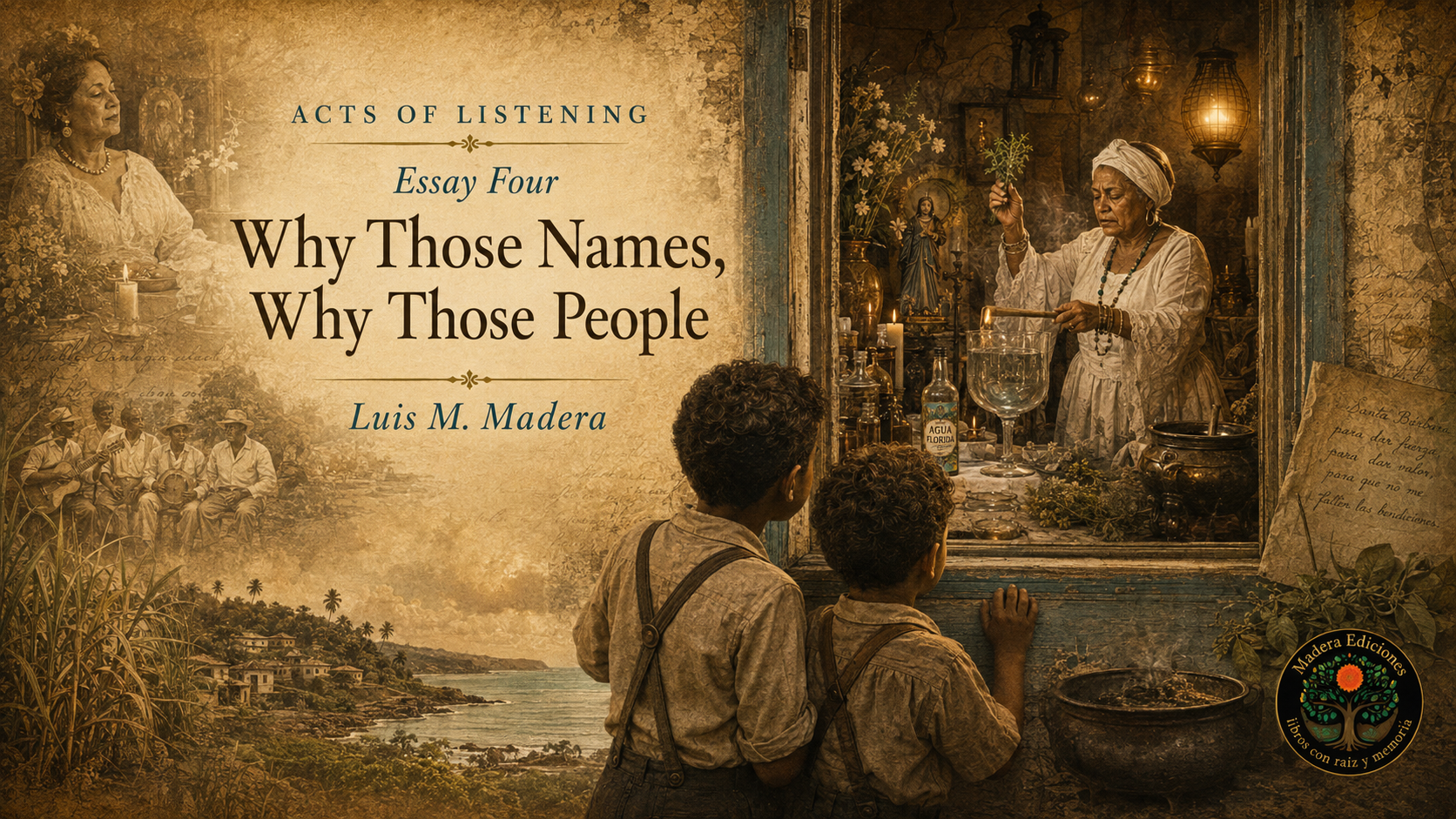
A family member recently asked me a question that stayed with me longer than I expected.
Why those names?
Why those people?
They were asking about the characters who keep appearing in my fiction. Some carry the names of people from my family. Others are shaped by gestures, stories, voices, and memories that belonged to people I knew or heard about growing up.
I understood the question.
Why Chefo?
Why Uncle Chico?
Why Geña?
Why return again and again to people whose lives unfolded in a small barrio surrounded by sugarcane and the Caribbean Sea?
I have been thinking about the answer.
I do not believe I chose them because they were unusual.
I think I chose them because they were there.
They formed part of the world that taught me how to recognize mystery long before I had language for it.
I remember Chefo most vividly through the stories surrounding her wake.
She was dressed carefully, as people were then when the dead were prepared to be received by family and neighbors. There was something solemn in the attention given to clothing, posture, prayer, and presence. Death did not erase the person. In some ways, it seemed to require even greater care.
And then there were the songs.
I remember hearing songs at the wake that I did not understand.
My grandfather Juan Francisco identified them for me as Mende.
At the time, I did not know what that meant.
I did not understand the history contained in the word or what it meant for an African language, or the memory of one, to remain present in a Puerto Rican family gathering.
I only knew that my grandfather recognized what I was hearing.
Someone older than me knew the name of the sound.
That has stayed with me.
Perhaps inheritance sometimes begins that simply.
A child hears something.
An elder says, This is what it is.
And the child carries the name long before he understands what he has been given.
Other stories reached me differently.
A second cousin told me about my paternal great-uncle Chico and a caldero associated with espiritismo.
I did not grow up examining these things as categories of belief. They arrived as family stories do: attached to names, houses, people, warnings, laughter, and the occasional lowering of a voice.
There were things everyone seemed to know and things no one explained completely.
Yet the silence around them was never empty.
It could carry reverence, approval, disapproval, warning, or simply the understanding that some things were not meant to be discussed casually.
As a child, I did not always know which of those meanings I was sensing.
I only knew that the adults around me did.
But one of my clearest memories belongs to my maternal great-aunt Geña.
She celebrated the feast of San Lázaro.
My brother and I were not supposed to be watching.
Of course, that made us want to watch even more.
We found a window.
I do not remember every detail of what was happening inside. Perhaps that is important. Memory has preserved the feeling more faithfully than the sequence.
There was prayer.
There was movement.
There was the sharp scent of Agua Florida and the smell of tabaco.
I remember the sound of a cuá striking a glass vessel filled with water, a small, insistent sound that seemed to belong to whatever was happening inside the room.
I did not understand what each thing meant.
No one stopped to explain it to us.
But explanation was not the only way meaning traveled in my family.
There were gestures, looks, reverence, approval and disapproval, all of it sometimes dressed in silence.
And there were two boys looking through a window at something we knew we were not supposed to be seeing.
We kept watching until, suddenly, the water from the glass vessel was thrown out through the window.
It fell on us.
For a moment, the boundary between what was happening inside and where we stood outside disappeared.
We ran.
And almost immediately, we ran straight into Tía Geña.
She was furious.
I remember more of her reprimand than I sometimes admit.
We were too close to her, she told us—family—and we were young and open, the kind of children she believed could be especially sensitive to what was happening inside that room.
Whether I understood any of that is another matter.
I knew only that we had done something much more serious in her eyes than look through a window.
Then she cleansed us.
Her anger did not disappear when the cleansing began.
It accompanied it.
There was Agua Florida.
Albahaca.
Other herbs rubbed across our skin.
Prayer.
Movement.
Her hands working quickly and deliberately, the reprimand still alive in her voice.
Years later, I can recognize something I could not have named then: her fury and her care were not opposites.
She was angry because, in the spiritual world she inhabited, she believed we had placed ourselves too close to something we did not understand.
And afterward there was food.
Plates were passed.
People ate.
The communal silence remained, but it was not empty.
Whatever boundary we had crossed, we had not been pushed outside the circle.
We had been reprimanded, cleansed, and then fed.
I do not tell this story now to judge what Geña believed.
I do not remember Uncle Chico in order to classify him.
I do not remember the Mende songs at Chefo’s wake in order to turn my family into evidence for an argument.
That would make the memories smaller than they are.
I think of them instead as stitches in a larger tapestry.
The barrio of my childhood was small.
Sugarcane surrounded us on three sides.
The Caribbean Sea held the fourth.
Within those boundaries lived people whose ways of understanding the world did not always fit neatly into categories.
There was Catholic devotion.
There were saints.
There was espiritismo.
There were remedies, prayers, warnings, stories of the dead, and ways of knowing when something should be approached carefully.
There were people who could identify songs whose origins reached far beyond the barrio.
There were people whose spiritual authority came from family, age, experience, reputation, or simply from the fact that everyone knew where to go when something happened.
None of this felt theoretical while I was growing up.
It was simply life.
Only much later did another thread enter the tapestry.
I was ordained.
With time, I realized that my ordination meant something within my family beyond the institutional role itself.
Relatives began to look toward me differently.
There were moments when I understood that, for some of them, I had become a new spiritual head within the family.
I am still cautious with that realization.
It would be easy to tell the story as though one form of spiritual authority replaced another.
That is not how I experienced it.
My ordination did not erase Geña.
It did not silence the stories of Uncle Chico.
It did not make my grandfather’s recognition of those Mende songs less significant.
If anything, it made me more attentive to how many people had carried spiritual responsibility before I ever wore a collar or stood at an altar.
Long before anyone called me Reverend, Father, minister, or anything else, I had already been surrounded by people who understood that the sacred could enter ordinary rooms.
Sometimes it arrived in prayer.
Sometimes in a song.
Sometimes in a saint.
Sometimes in a warning not to look through a window.
I had been learning before I knew I was learning.
Perhaps that is part of the answer to the question.
Why those names?
Why those people?
Because when I began to write, I discovered that they were already there.
They had entered my imagination before I ever thought of myself as a writer.
They had taught me that the visible world was not necessarily the whole world.
They had taught me that people carried things they did not always explain.
They had taught me that faith could be formal and intimate, public and private, inherited and improvised.
They had taught me that mystery did not always require resolution.
And so they entered the fiction.
Not exactly as they were.
Fiction cannot do that.
Memory cannot do that either.
I do not know everything Chefo understood.
I do not know everything Uncle Chico believed.
I cannot recover every word spoken inside Geña’s house on the feast of San Lázaro.
I do not know everything my grandfather carried within him when he recognized those songs.
There are silences I have no right to fill.
But fiction allows me to stand near them.
It allows me to listen for what remains.
That responsibility matters to me.
If I use a name, I do not want the person behind it to become a curiosity.
If I remember a spiritual practice, I do not want to reduce it to folklore.
If I write about people from a poor barrio, I do not want hardship to become scenery.
They deserve the same complexity on the page that they possessed in life.
They laughed.
They contradicted themselves.
They believed.
They doubted.
They worked.
They prayed.
They gossiped.
They cared for children.
They buried their dead.
They carried histories they may not have known how to name.
And some of those histories reached me.
Perhaps that is why the question stayed with me.
Why those names?
Why those people?
Because they were never background characters to me.
They were part of the world that made me.
I once thought I was only a child listening at a wake, hearing a language I did not understand.
I thought I was only one of two boys peering through Geña’s window at something we had been told not to see.
I thought the adults were simply telling stories about Uncle Chico.
I did not know that I was being given pieces of a world.
Years later, I would enter other rooms.
I would study theology.
I would be ordained.
I would write novels.
I would begin asking questions about history, ancestry, memory, and the lives that disappear when no one thinks to record them—or when the people charged with recording history, shaped by the hierarchies of their time, gave some lives only a line while allowing others to occupy the page.
And somehow, those people were waiting for me there.
Perhaps that is why their names keep returning.
I first met them before I understood that one day I would be responsible for remembering them.