The Name They Left Out
By Luis M. Madera Suárez
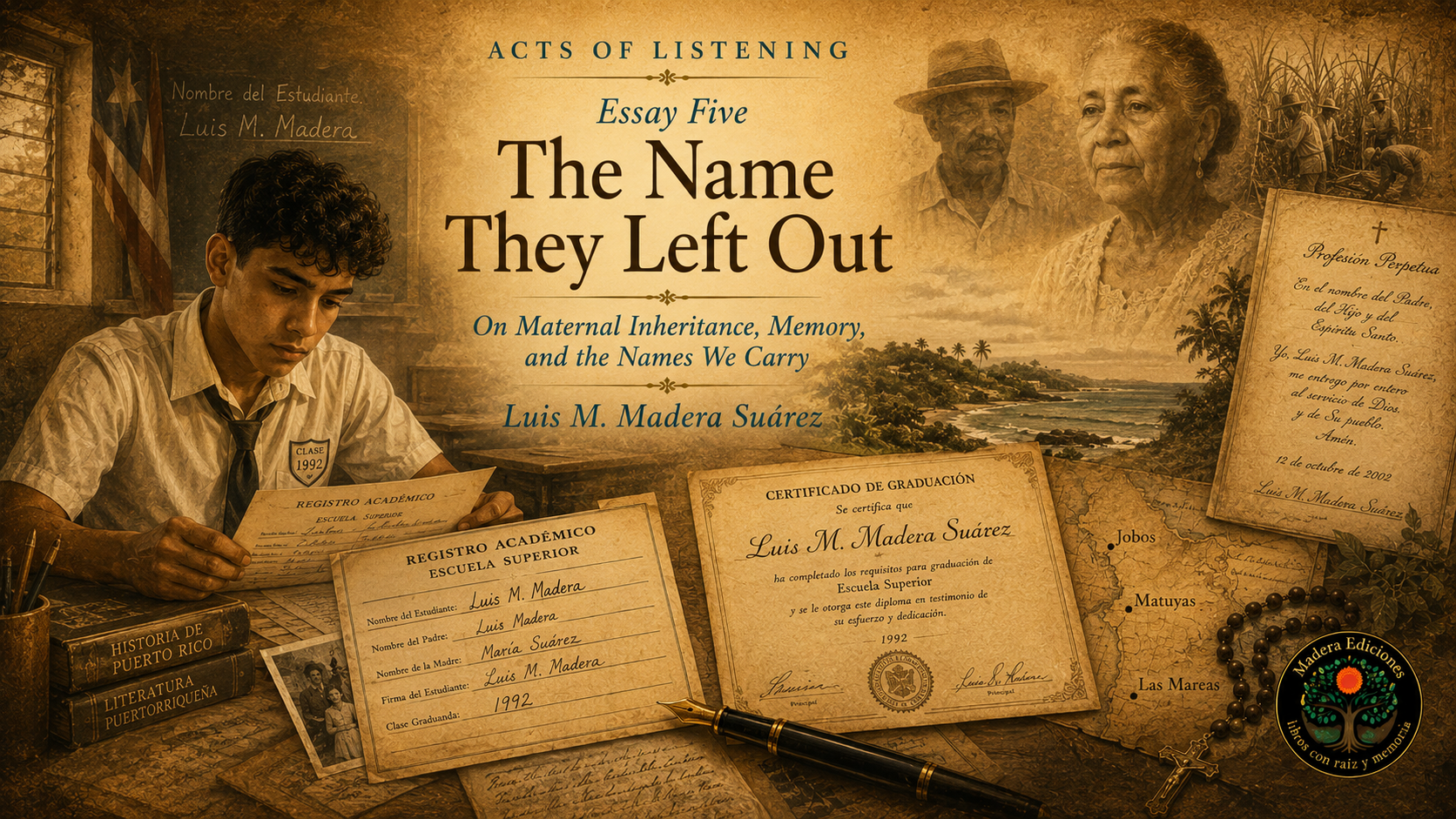
When I was registered for high school in the United States, part of my name disappeared.
No one asked me.
I arrived as Luis M. Madera Suárez.
I became Luis M. Madera.
At the time, I did not have enough English to know how to challenge it. I knew something was wrong. I knew something important had been removed. But knowing that something matters and knowing how to defend it are not always the same thing.
So the record remained.
Luis M. Madera.
For most people around me, that was probably an ordinary name.
For me, it was incomplete.
Suárez was my mother’s surname.
It was not an ornament attached to the end of mine. It was not an optional second surname that could be dropped when a form became inconvenient. It carried a side of my family, a history, a way of belonging.
But the systems I encountered did not seem to know what to do with it.
Sometimes there was not enough space on the form.
Sometimes there was a box for “last name,” singular.
Sometimes I tried a hyphen.
Madera-Suárez.
That seemed as though it should solve the problem.
Often it did not.
People hesitated over it. They separated the names. They rearranged them. They dropped one anyway.
For a while, I wondered whether I was the one who did not understand.
Maybe I did not know how the hyphen worked.
Maybe I had entered the information incorrectly.
My English was still developing, and when other people seemed certain, it was easy to assume that the confusion belonged to me.
I was not a child. I was in my final year of high school, old enough to know that something about the shortened name bothered me, but not yet confident enough in English to argue for what I wanted.
Sometimes I even wondered whether my handwriting was the problem. My penmanship was large, so I tried writing smaller, squeezing the letters together, hoping I could make both surnames fit inside the space provided.
Sometimes I could.
Sometimes I still could not.
Eventually, I would give up.
Madera would have to do.
But it still bothered me.
In college, that resignation began to change.
I started noticing other people who had kept both surnames.
That bothered me too, but in a different way.
If their names could fit, why couldn’t mine?
Was it because I was now in New York City, where people were more accustomed to Spanish naming traditions? Did people there simply understand better that two surnames were not a mistake to be corrected? Had someone finally learned how to make room?
I did not yet have a complete answer.
But for the first time, I began to understand that the problem might never have been the length of my name.
That first omission followed me.
It followed me through college.
It followed me through graduate school.
Even now, in much of my life in the United States, I am known simply as Luis M. Madera.
There is nothing false about that name.
It is mine.
But it is not all of mine.
Perhaps that is why religious life became so important in a way I did not fully understand at first.
When I made simple vows, I had another opportunity to say who I was.
This time, I knew enough to insist.
My full name appeared:
Brother Luis M. Madera Suárez, O.S.A.
One of my novitiate classmates remarked that it was a pretty long name.
It was.
I did not care.
There was room in it for everyone.
I made the same choice at solemn vows.
Later, I carried the same name as:
Rev. Deacon Luis M. Madera Suárez, O.S.A.
And eventually as:
Reverend Luis M. Madera Suárez, O.S.A.
At times, people simply called me Friar Luis.
The title changed.
The name did not.
In religious life, in the United States and in Rome, there was room for both surnames.
Sometimes my family and I laugh when someone in a movie dramatically recites a long string of names and surnames.
To someone else, all those names may sound excessive. To me, there is something familiar in the insistence that no one be left out.
That mattered to me more than I knew how to explain at the time.
My mother was too important to me.
The identity and pride carried in her name were too important.
I had already watched that part of me disappear once through something as ordinary as a school record.
I did not want it erased again.
Names seem simple until someone removes part of yours.
Then you discover how much can live inside a few letters.
A surname can carry a parent.
A grandmother.
A barrio.
A language.
A story you inherited before you understood it.
It can carry people whose faces you remember clearly and others whose names survive only in records.
It can carry pride.
It can also carry absence.
For years, I thought of Suárez mainly as something that had been dropped from my name.
Only later did I begin to understand that it had never actually disappeared.
It remained in my family.
It remained in the way I understood myself.
It remained in the people whose stories I carried.
The paperwork had changed.
I had not.
When I think of Suárez, I do not think first of a name on a form.
I see faces.
I see my grandfather.
I see his mother, Belén. I know her face because a photograph of her survives. My mother told me that Belén was there when I was born and that she died three years later. I have no memory of those first years with her, but knowing that she saw me, that she knew I had arrived, places us within the same living story.
And I see places.
Jobos. Matuyas. Las Mareas.
Places that later entered my novels but belonged to my family long before they belonged to my fiction. Somehow Suárez calls up those landscapes for me, while Madera carries another line of people, places, and memory.
That is what my full name holds.
Not only letters.
People. Places. Inheritance.
Perhaps that, too, is an act of listening: allowing a name to call back the people and places inside it.
Perhaps listening is not always about hearing another person speak. Sometimes it is learning to pay attention to what has been missing. For years, Suárez remained in the silence between the name I was given and the name institutions used for me. I did not yet have the language to defend it, but I had never stopped noticing its absence. Eventually, I learned to listen to that discomfort. It was telling me that something mattered.
And when I began searching the names of those who came before me, I understood the lesson differently. A name on a page can be evidence. A missing name can be evidence too. Both ask us to pay attention.
Perhaps that is why, when I eventually began publishing books, the question returned.
What name would appear on the cover?
By then, I had founded Madera Ediciones.
I chose that name deliberately.
It worked.
It was clear.
It was memorable.
It made sense as a brand.
A company name has different responsibilities from a human one.
Madera Ediciones could remain Madera Ediciones.
But the author could not.
On my books, I wanted the whole name.
Luis M. Madera Suárez.
That decision was not about making the name more distinctive.
It was not about sounding more Puerto Rican.
It was not even primarily about correcting an old administrative mistake.
It was about refusing the habit of omission.
I was not adding Suárez.
I was putting back what had always been mine.
There is something strange about spending years trying to make yourself fit inside forms.
You learn where to abbreviate.
You learn what to leave out.
You learn which part of yourself a system considers necessary and which part it treats as excess.
Most of the time, no one means harm.
That may be what makes these losses so easy to overlook.
A clerk enters what fits.
A database accepts what it recognizes.
A school record reproduces the information it was given.
The shortened version moves from one institution to another until eventually it begins to look official.
And what is repeated often enough can start to feel inevitable.
But inevitability is not the same as truth.
I think now about all the names I have encountered in historical records.
Some stretch across a line.
Some have been shortened.
Some are misspelled.
Some appear differently from one document to another.
Some women become difficult to follow because their names shift with marriage or because the person recording them considered one part of their identity more important than another.
Sometimes a person is given a full paragraph.
Sometimes only a line.
Sometimes only a name.
Sometimes not even that.
The people charged with recording history were shaped by the hierarchies of their time. Some lives were allowed to occupy the page. Others were compressed into the smallest possible space.
Perhaps that is one reason my own missing surname has stayed with me.
The scale is different, of course.
My name was not erased from history.
I was not denied a record.
But I learned, in a small and personal way, what it feels like when someone else’s system decides which part of you is necessary.
No one asked me.
That remains the part I remember most.
No one asked whether Suárez mattered.
No one asked whether it was my mother’s name.
No one asked whether I wanted to keep it.
The form simply moved on.
Years later, I learned that I could stop moving with it.
At each important moment when I had the chance to name myself, I chose the whole name.
At vows.
At the diaconate.
At ordination.
In Rome.
On the covers of my books.
There is no drama in that.
No grand act of resistance.
Just a name written fully.
But perhaps reclamation is often quieter than we imagine.
Sometimes it is simply listening closely enough to recognize what has been left out—and refusing to leave it out again.
I have come to think that names are not only labels for the living.
They are one of the ways the dead continue traveling with us.
Madera carries one line.
Suárez carries another.
Together they tell a truth about where I come from that neither can tell alone.
I do not know whether everyone who sees my name on a book cover understands that.
They do not need to.
I do.
For most of my life in the United States, people have known me as Luis M. Madera.
That name belongs to me.
But when I write, I choose to place something else on the page.
Luis M. Madera Suárez.
Not because I became someone new.
Because I finally had enough language, enough confidence, and enough authority over my own name to stop leaving part of myself behind.