The Unnamed Mothers and Fathers of the Nation
By Luis M. Madera Suárez
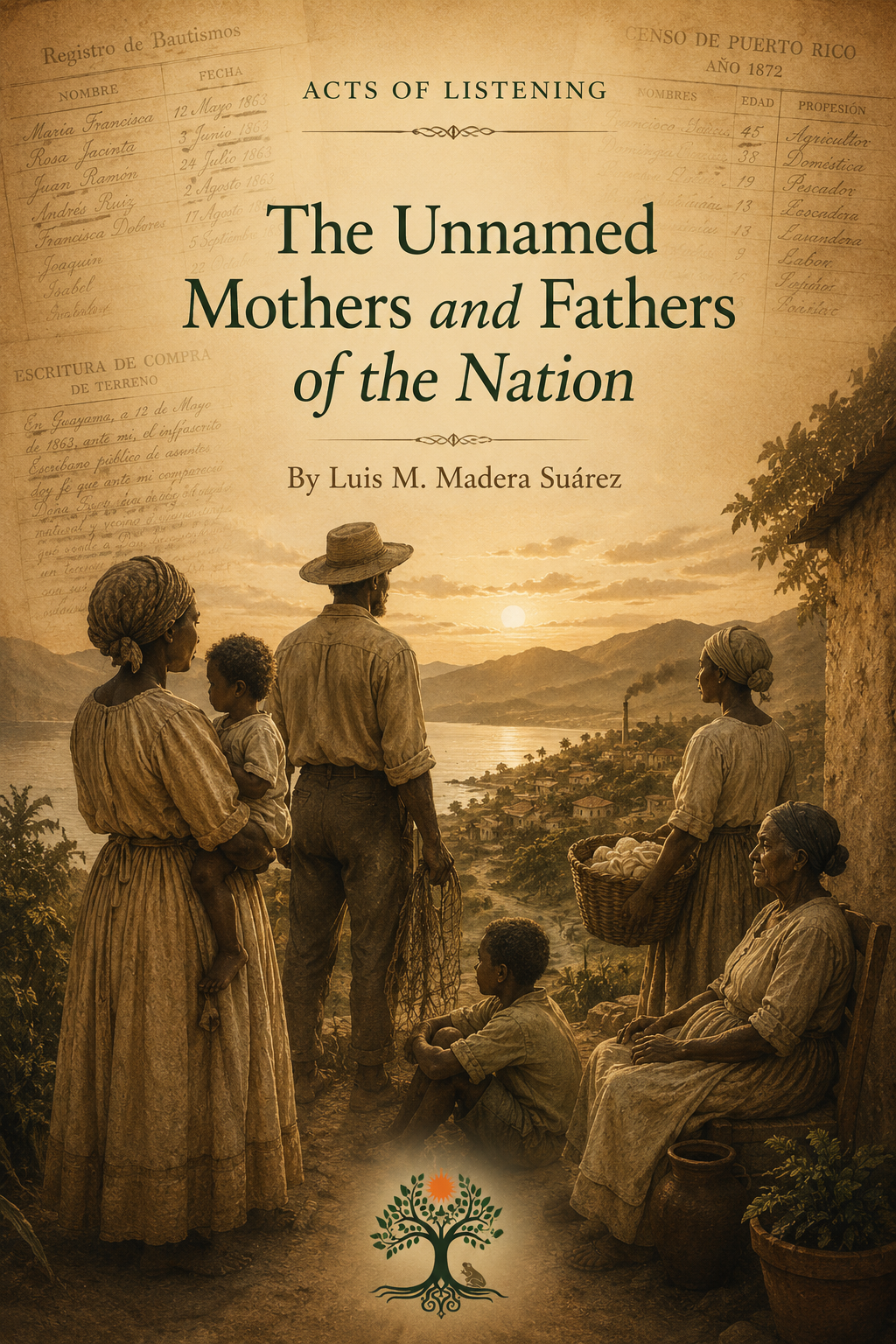
The older I become, the less interested I am in asking who made history.
I find myself wondering about the people who quietly carried it from one generation to the next.
Their names rarely appear on monuments.
Yet I suspect we are living because they did.
History has taught us to remember its defining moments. We learn the dates of revolutions, the names of leaders, the speeches that stirred hearts, and the courage of those who confronted injustice in public view. Those stories matter. They deserve to be remembered and retold, for they remind us that freedom has often demanded extraordinary sacrifice.
But history is not carried forward by extraordinary moments alone.
Between the uprisings and the proclamations, ordinary life continued. Children were born. Families mourned their dead. Fields were planted and harvested. Bread was baked. Songs were sung. Prayers were whispered over cradles and graves. Neighbors shared what little they had after storms. Parents taught their children not only how to survive, but how to remain human.
The older I become, the more I find myself drawn to those quieter stories.
Perhaps it is because they are harder to see. Archives rarely linger over them. Parish registers record a baptism, a marriage, or a burial, then move on to the next name. Census records tell us where someone lived, how old they were, whether they could read or write, and sometimes where their parents had been born, preserving traces of journeys that families themselves may no longer remember. A will may list a few possessions before the paper falls silent.
Yet between those few surviving lines was an entire life.
Someone laughed.
Someone worried about tomorrow.
Someone fell in love.
Someone carried grief that no document could ever describe.
Someone made sacrifices so their children—or perhaps someone else’s children—might inherit a future they themselves would never see.
The archive can tell me where a family lived. It cannot tell me what songs a mother sang while rocking her child to sleep, what prayer a fisherman whispered before putting out to sea, or what hopes parents quietly entrusted to the next generation.
I think of my own grandmother. Years later, my mother told me that my grandmother had been a comadrona. As a child, I knew none of that. I only knew that when my stomach hurt, she would lay me on her old four-poster bed, its wooden posts carved to look as though the wood itself had been twisted. She would reach for a bottle of Alcoholado Superior 70. The liquid had a soft yellowish tint from the herbs she kept steeping in it. She would pour a little into the palm of her hand, rub my stomach gently, whisper words too soft for me to understand, and leave a few tiny leaves of what I believe was albahaca resting on my skin.
I still remember the smell of nicotine, Maja soap, and face powder. I do not remember whether the sobo cured my stomachache. I remember feeling safe. Only later did I realize I was not simply being comforted by my grandmother. I was being cared for by a woman whose hands had welcomed children into the world and whose knowledge had been carried from one generation to the next.
No census would have recorded the bottle on her nightstand. No parish register would have mentioned the herbs steeping in alcohol, the whispered words, or those few leaves resting on a child’s stomach. Those things survived somewhere else. They survived in memory, in touch, in families, and in the quiet rituals of everyday life.